
Censorship is the control, suppression, or restriction of information, speech, images, or media by an authority such as a government, organization, or institution. It is commonly used to regulate content considered harmful, sensitive, or inappropriate for public access.
In today’s digital age, censorship affects news, films, television, books, social media, and the internet, making it a topic of constant debate worldwide.
Table of Contents
What Is Censorship?
Censorship refers to the act of reviewing, altering, blocking, or banning content before it reaches the public. This content can include:
- Written material (books, articles)
- Visual media (films, TV shows)
- Online platforms (websites, social networks)
- Speech and artistic expression
The purpose of censorship varies — from protecting national security and public morality to controlling misinformation or political dissent.
Why Is Censorship Used?
Authorities apply censorship for several reasons:
- To protect minors from harmful content
- To maintain national security
- To prevent hate speech or violence
- To control misinformation
- To preserve cultural or religious values
However, the same tools can also be misused to suppress freedom of expression.
Types of Censorship
1. Government Censorship
Imposed by state authorities to regulate political, social, or national-security-related content.
Example: Blocking news websites during political unrest.
2. Media Censorship
Content in newspapers, television, radio, or films is edited or restricted before publication or broadcast.
Example: Scenes removed from movies before release.
3. Internet Censorship
Restrictions placed on websites, apps, social media platforms, or online information.
Example: Blocking social media platforms or search terms.
4. Self-Censorship
When individuals or organizations voluntarily restrict their own expression to avoid backlash, legal issues, or social consequences.
5. Religious or Cultural Censorship
Content restricted to protect religious sentiments or cultural norms.
Examples of Censorship
| Area | Example |
| Films | Scenes cut due to violence or nudity |
| Books | Banning books with political or controversial ideas |
| Internet | Blocking websites or keywords |
| News | Suppression of sensitive reports |
| Social Media | Removal of posts violating policies |
Censorship in Film and Television
Film censorship is common worldwide. Movies and TV shows often go through review boards that:
- Assign age ratings
- Remove explicit scenes
- Modify dialogues
This aims to make content suitable for different age groups and cultural standards.
Advantages of Censorship
- Protects children from harmful content
- Prevents spread of hate speech
- Helps maintain public order
- Reduces exposure to extreme violence or misinformation
Disadvantages of Censorship
- Limits freedom of speech
- Suppresses creativity and art
- Can be misused for political control
- Restricts access to information
Censorship vs Freedom of Speech
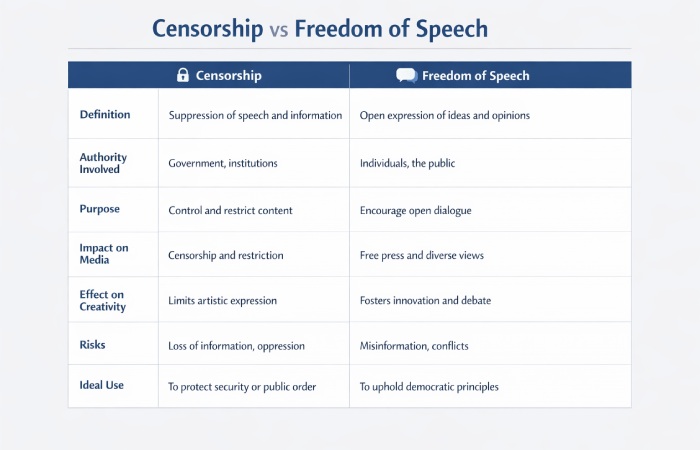 Censorship and freedom of speech often conflict. While freedom of speech promotes open expression, censorship introduces boundaries. A balance is necessary to ensure safety without silencing voices.
Is Censorship Always Bad?
Not always. Responsible censorship can protect society, but excessive censorship can harm democracy, creativity, and transparency. The impact depends on how, why, and by whom it is applied.
What is digital censorship?
Digital censorship refers to controlling online content such as websites, apps, and social media posts.
Final Thoughts
Censorship plays a powerful role in shaping what people see, read, and hear. While it can protect society from harm, it also raises serious questions about freedom, transparency, and control — especially in the digital era.
Frequently Asked Questions (FAQs) About Censorship
What is censorship in simple words?
Censorship means controlling or restricting information, speech, images, or media so that certain content is not shared with the public. It is usually done by governments, institutions, or platforms.
Why do governments use censorship?
Governments use censorship to protect national security, maintain public order, prevent hate speech, and control misinformation. However, excessive censorship can limit freedom of expression.
What are the main types of censorship?
The main types of censorship include:
- Government censorship
- Media censorship
- Internet censorship
- Self-censorship
- Religious or cultural censorship
Each type affects different forms of communication and media.
Is censorship legal?
Yes, censorship is legal in many countries, but the rules and limits vary depending on national laws, constitutions, and court rulings.
What is internet censorship?
Internet censorship refers to blocking, filtering, or restricting access to online content, such as websites, apps, social media platforms, or search results.
How does censorship affect freedom of speech?
Censorship can limit freedom of speech by restricting what people are allowed to say or share. A balance is often needed to protect society while preserving individual rights.
Is censorship always bad?
No. Responsible censorship can protect children, prevent violence, and reduce harmful content. Problems arise when censorship is misused for political control or silencing opinions.
Who decides what content gets censored?
Content may be censored by:
- Governments and regulatory authorities
- Media boards and publishers
- Social media platforms
- Website owners
The decision depends on the platform and local laws.
What is self-censorship?
Self-censorship happens when individuals or organizations voluntarily restrict their own expression due to fear of backlash, legal action, or social pressure.
Does censorship exist on social media?
Yes. Social media platforms moderate content based on community guidelines, platform policies, and local laws, which is a form of censorship.